Why quit
Six findings worth quitting over.
Brain scans, a survey of 3,419 young men, and trials of what helps. Each finding links to the study it came from, and says only what that study found.
01 · Brain scans · Cambridge, 2014
Wanting it more. Not clearly liking it more.
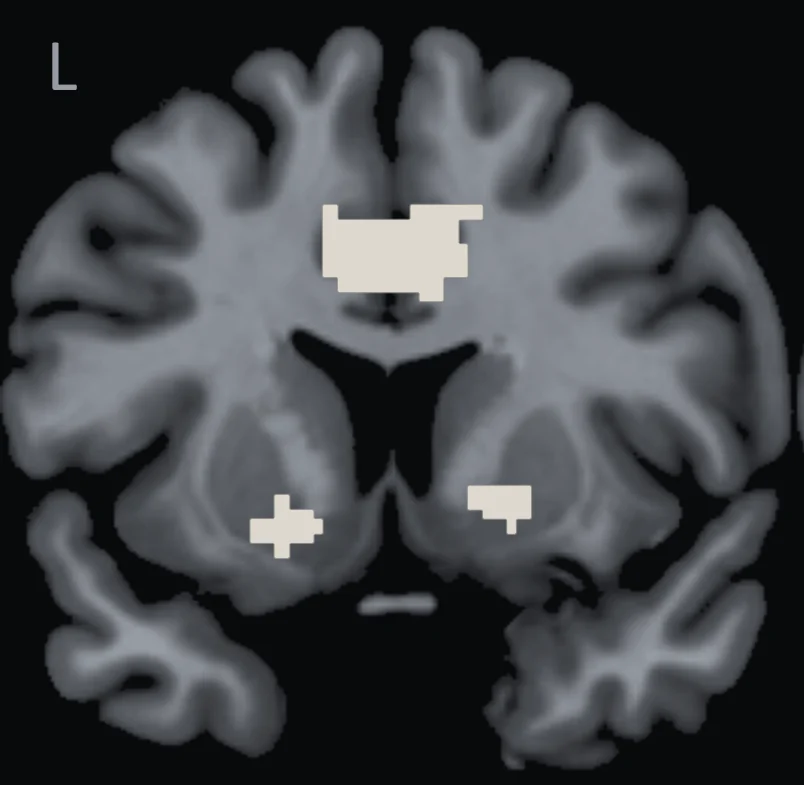
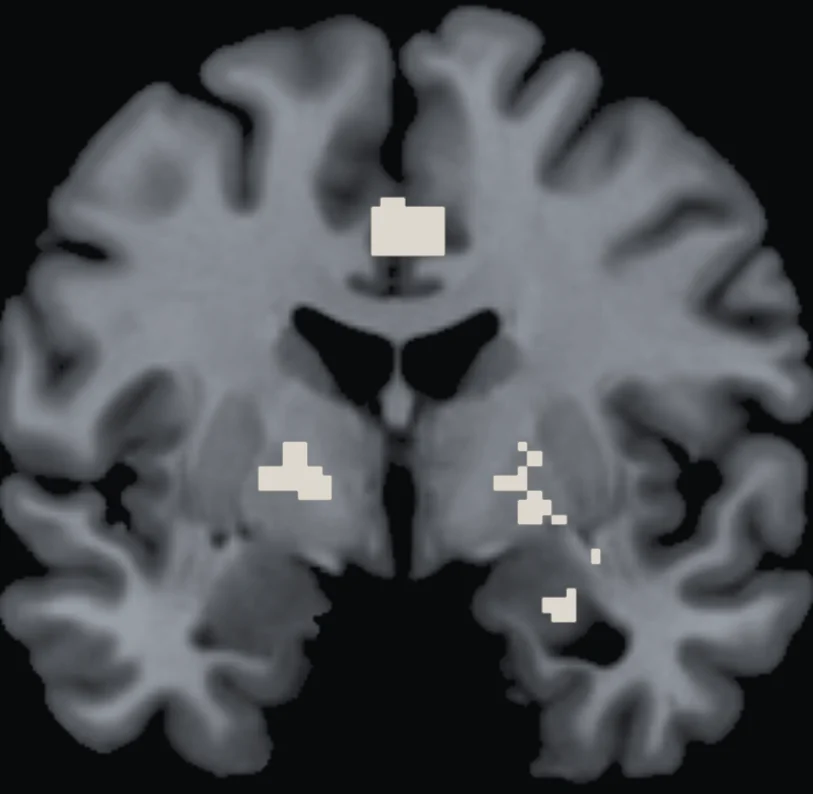
In bone: where the men with compulsive use responded more to explicit clips, compared with sports clips, than the men without it. These are the ventral striatum, the dorsal cingulate and the amygdala.
Figure 2 from Voon V, et al. (2014), PLoS ONE 9(7): e102419, doi.org/10.1371/journal.pone.0102419, licensed CC BY 4.0. Cropped and recoloured.
Cambridge researchers scanned 19 men whose porn use was out of their control, and 19 men without the problem, while both groups watched short explicit clips.
In the first group, three of the brain’s reward and craving areas responded more strongly. Those men rated the clips as more wanted, but not significantly more liked.
The researchers compare the pattern to how drug cues light up the brains of addicts in earlier studies.
Source: Voon et al., PLOS ONE, 2014
02 · Brain scans · Berlin, 2014
More hours, less grey matter in a reward area.
Researchers in Berlin scanned 64 healthy men. The more hours a man watched, the less grey matter he had in the right caudate, a part of the brain’s reward system. A nearby reward area, the left putamen, also responded less to sexual pictures the more he watched.
This was not a study of heavy users. On average the men watched about four hours a week, and the link was measured across all 64 of them, not only the heaviest.
03 · Surveys and a study of 61 men
Porn as an escape goes with losing control.
-
The moment
Stress, boredom, a hard feeling.
Three of the reasons people give in surveys for why they watch.
-
The exit
Porn, to switch it off.
People who watch to get away from feelings like these are more likely to report that their use is out of control.
-
The lift
Calm, right after.
In a study of 61 men, calm rose clearly and mood a little, straight after watching to climax.
The researchers behind the 61-man study call that lift reinforcing: a reward that strengthens the habit it follows.
Sources: Bőthe et al., Psychology of Addictive Behaviors, 2021 · Laier & Brand, Addictive Behaviors Reports, 2017
04 · Survey of 3,419 men · 2021
Erection problems went with problem porn use.
21.5%of the 2,067 sexually active men aged 18 to 35 in the survey had some degree of erectile dysfunction.
| What went with it | Odds of erectile dysfunction |
|---|---|
| Each extra point on a problem-porn-use test | About 6% higher |
| Finding real sex less arousing than porn | 2.3 times as high |
| How often they masturbated | No significant link |
The test is 11 questions about problematic porn use.
Source: Jacobs et al., JMIR Public Health and Surveillance, 2021 · mostly Belgian and Danish men
One fix with trial evidence: pelvic-floor training.
In a randomised trial, 55 men with erectile dysfunction did either pelvic-floor exercises plus lifestyle advice, or lifestyle advice alone. After three months, the exercise group scored about twice as high.
The men’s median age was 59. Erection problems that last are worth a visit to a doctor.
Average erection score after three months, out of 30.
Source: Dorey et al., British Journal of General Practice, 2004
05 · An experiment and 104 quit diaries
Three weeks off porn. Then they mostly chose to wait.
- 81%Gave up porn
- 51%Gave up a favourite food
37 students who watched porn were split at random: give up porn, or give up a favourite food, for three weeks. The food group kept watching.
Then each chose between raffle tickets now or more tickets later. The porn quitters waited for the bigger prize 81% of the time. The food quitters waited 51% of the time.
In 104 online quit diaries, 42 men started out with erection problems. 21 of them reported at least some improvement.
Sources: Negash et al., Journal of Sex Research, 2016 · Fernandez, Kuss & Griffiths, Archives of Sexual Behavior, 2021
06 · What helps
Therapy has a trial behind it. A blocker puts a barrier in the way.
- Has a trial
Group therapy. In a Swedish trial of 137 men with out-of-control sexual behaviour, seven weeks of group cognitive behavioural therapy (CBT, a talking therapy that works on habits and thoughts) cut symptoms more than waiting did.
- Adds friction
A blocker. Men writing quit diaries said a blocker could usually be got around, but it put one more barrier in front of a weak moment.
- Seemed to matter most
Other people. In the same diaries, the authors judged support from other people more useful than blocking apps.
Sources: Hallberg et al., Journal of Sexual Medicine, 2019 · Fernandez, Kuss & Griffiths, Archives of Sexual Behavior, 2021
Basalt is the barrier, built so it can’t be switched off in a weak moment. Turning it off takes the waiting period you set.